

Exploring what’s next
Innovation Hub
We explore, validate and turn emerging technologies into solutions with real-world impact.
How we innovate

Explore
We identify and assess emerging technologies and market trends.

Experiment
We build prototypes and proofs of concept in controlled environments.

Validate
We assess technical feasibility and measure the potential impact of each solution.

Industrialise
We turn proven outcomes into accelerators and solutions ready for our clients.

Telecom Lab
Intelligence for the networks of tomorrow
Telecom Lab is where we explore the evolution of telecom networks and how AI can make them more autonomous, efficient and sustainable.
We work across cloud-native architectures, Open RAN, network automation, SMO platforms, rApps, advanced data analytics and AI-assisted operations, collaborating with leading vendors and operators across the industry.
- AI for network operations.
- Open RAN and O-RAN ecosystems.
- rApps and intelligent automation.
- Network analytics.
- Energy optimisation.
- Private 5G networks.
- Edge computing.
- Zero-touch operations.
Projects
Radio Resource management in O-RAN
Virtualised resource management in O-RAN
Integrated E2E network-wide management
Energy-efficiency and security in O-RAN

AI Lab
Turning AI potential into business value
AI Lab is where we design, train and validate AI-powered solutions before bringing them into real-world projects.
We explore emerging architectures, foundation models, AI agents, multimodal systems and Responsible AI platforms to build reliable, scalable solutions aligned with our clients’ objectives.
Our approach combines applied research with a strong business focus, helping organisations accelerate AI adoption while maintaining security, control and measurable outcomes.
- Generative AI.
- AI agents.
- RAG and knowledge systems.
- Intelligent automation.
- Multimodal AI.
- Computer vision.
- MLOps and LLMOps.
- Responsible AI and AI governance.
Projects
Speech-to-Text REST API
A project using speech-to-text (STT) technologies, including automatic speech recognition (ASR) and speaker diarisation, to transcribe court proceedings and identify individual speakers.
A REST API was developed to enable straightforward integration with existing systems.
AIRE – AI Router Expert
An AI-powered chatbot built using RAG technology that acts as a ‘Router Expert’, helping end users configure their routers across the models supported by the company.
The solution implements a Retrieval-Augmented Generation (RAG) architecture based on an open-source LLM (Llama 3.1 70B), a Qdrant vector database and a Python-based controller exposed through a REST API.
R&D and Innovation Project: SIEM+AI
The solution detects and classifies cyberattacks within network traffic. Neural networks are applied to both public and synthetically generated datasets to identify network traffic anomalies.
The relevant features used for binary classification are surfaced for expert validation.
Detected attacks are then clustered using unsupervised learning techniques and large language models (LLMs) to determine the specific type of attack.

O-RAN Lab
A real network for experimentation
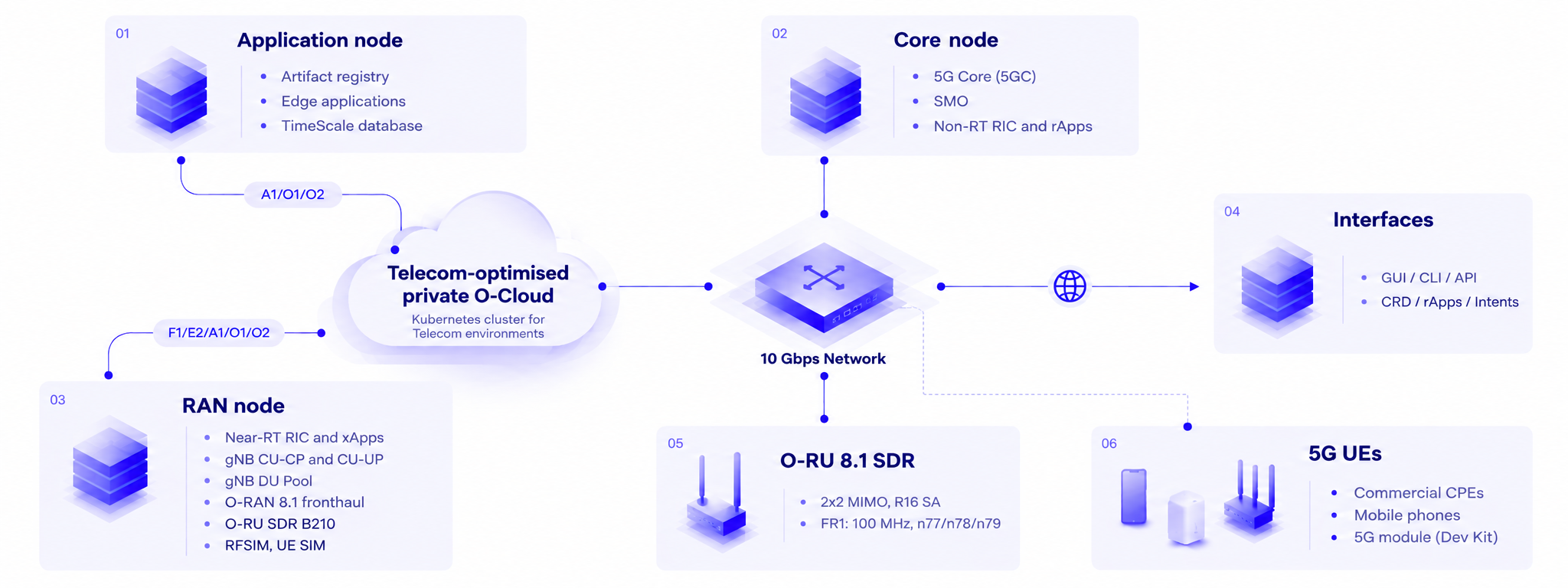
Through our Telecom Lab, we have built our own O-RAN infrastructure to research, develop and validate new network capabilities in a controlled environment.
Our lab replicates the key components of an Open RAN architecture, enabling us to work on automation, network intelligence, resource optimisation, and new xApps and rApps before deploying them in operational environments.
- O-CLOUD: Telco-optimized K8s Cluster.
- SMO/OAM: O-RAN SMO.
- RIC: O-RAN near-RT + Non-RT RIC.
- Service Models: KPM (KPIs Measurement), RC (Radio Control) and CCC (Cell Configuration & Control).
- xApps: Monitoring, slicing, LB, Traffic and QoS.
- rApps: FlexPolicy, FlexMon.
- gNodeB (vBS): OAI (Open Air Interface), SRSran.
- RRU: USRP B210.
- Mobile phones, commercial CPE and Quectel 5G module.
- vRAN: shared computing platform composed of a commercial off-the-shelf (COTS) computer equipped with a 16-core Intel i9 14900K CPU.
- near-RT RIC: Co-located with the vBS and implemented using FlexRIC.
- SMO: hosts the non-RT RIC. For the non-RT RIC we use the open source implementation from the O-RAN Software Community (OSC), while the 5G Core VNFs can be deployed using Open5GS or OAI as Docker containers.
- Testbed: includes an application server that can be used for hosting applications, traffic generation, and data storage.
Let’s talk
We look at every challenge in its real-world context to determine what’s worth building — and the right way to build it.